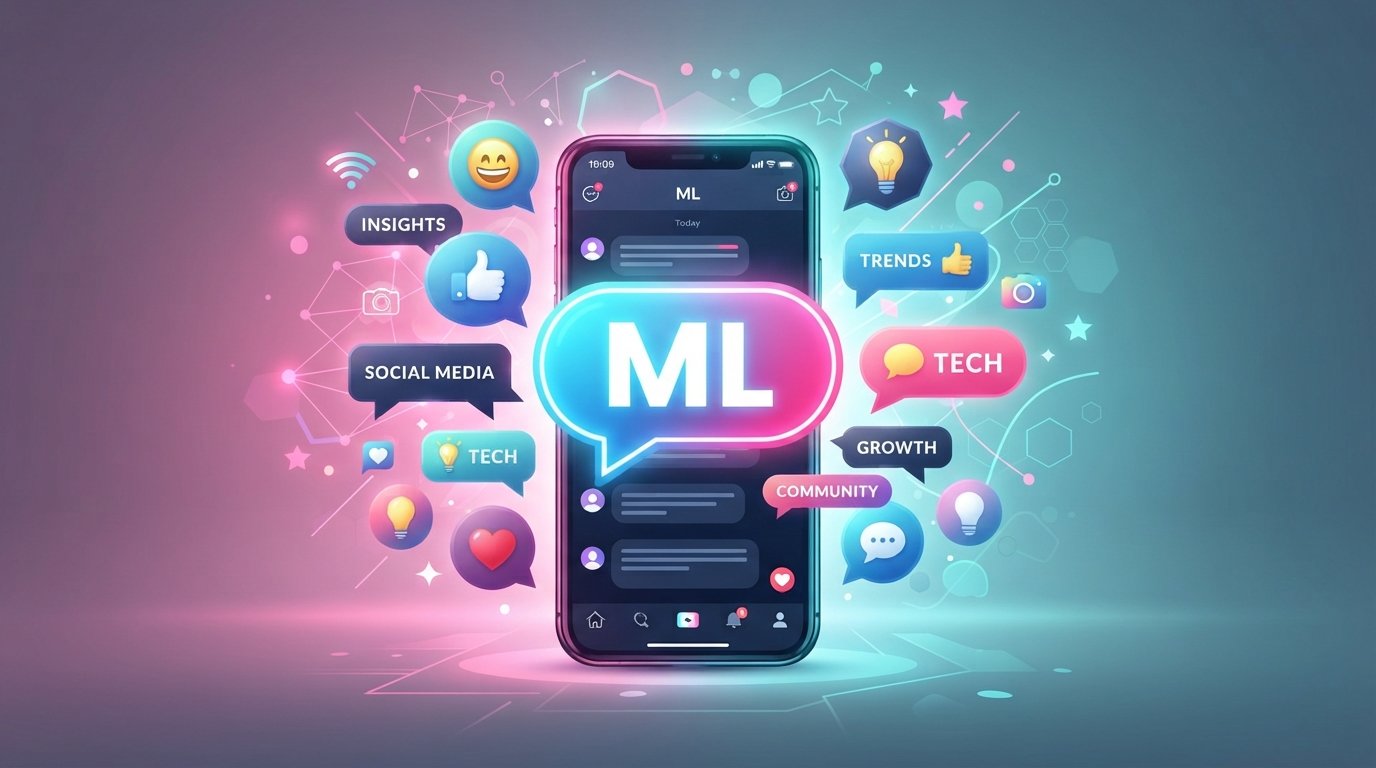
ML meaning in text refers to the shorthand “ml,” most commonly used across texting and social media to express “Much Love,” a warm, casual sign-off between friends or followers. The same two letters also carry other meanings depending on context, from Mobile Legends in gaming chats to machine learning in tech conversations.
Two letters, five different meanings, and one confused reader staring at their phone. That’s the reality of modern text slang, where a single abbreviation can shift its entire identity based on who sent it.
This guide breaks down every real use of ML, from everyday conversations to gaming chat, so you’ll never misread a message again.
What Does ML Mean in Text?
In most casual chat and texting situations, ML stands for “Much Love.” People drop it at the end of a message the way you’d sign off a letter, except way faster and way less formal.
But that’s not the whole story. ML also shows up as shorthand for Machine Learning in tech conversations, as a nod to Mobile Legends in gaming chat, and occasionally as a plain old measurement abbreviation for milliliter. The letters stay the same. The meaning shifts entirely based on context.
Think of ML like the word “bank.” Nobody gets confused when someone says “I’m heading to the bank” versus “we sat on the river bank,” because the surrounding words do the heavy lifting. Text slang works the same way. You just need to know what to look for, and that’s exactly what this guide walks you through.
ML Full Form: “Much Love” and Its Main Variations
The most common full form of ML in casual messaging is simple: Much Love. It’s a warm, low-effort way to close out a message without writing three whole words.
You’ll see it written a few different ways:
- ml (lowercase, most common in texting)
- ML (capitalized, often in captions or more visible posts)
- m.l. (rare, but shows up occasionally in older texting habits)
There’s no strict rule about capitalization. Lowercase tends to feel more casual and quick, almost like a whisper at the end of a sentence. Capitalized versions show up more in social media captions, where formatting carries a bit more weight.
Quick note: ML isn’t the only abbreviation that expands to “Much Love.” Some people write “ML” and others write out “much love” in full when they want extra emphasis. The shorthand version just moves faster, which matters a lot when you’re firing off replies between meetings or during a commute.
Where “ML” Came From
Text slang doesn’t appear out of nowhere. It grows out of necessity, laziness, and a genuine desire to communicate warmth without typing a full sentence.
Back when SMS messages came with character limits and typing on a numeric keypad meant pressing the same button three times just to get a “C,” abbreviation culture exploded. BRB, TTYL, LOL, and eventually ML all trace back to this era. People needed shortcuts, and once a shortcut caught on, it spread through group chats, then message boards, then eventually into the DNA of how an entire generation communicates.
ML specifically gained traction as a sign-off, similar to how people used to write “Yours truly” or “Take care” at the end of letters. It carries the same emotional weight but takes a fraction of the effort.
Here’s a fun comparison: in the 1990s, people ended AIM conversations with things like “ttyl :)” and pager codes carried their own coded meanings (143 meant “I love you,” based on letter counts). ML fits into that same lineage, just adapted for a texting-first world.
“Slang abbreviations survive because they solve a real problem: saying something meaningful in the least amount of time possible.” — this is basically the unwritten rule behind every piece of internet shorthand that’s stuck around.
Once texting habits moved onto social platforms like Instagram and Twitter, ML made the jump too. It didn’t need reinventing. It just needed an audience that was already primed to understand abbreviation culture.
ML Meaning by Context — A Quick Comparison
Since ML carries multiple meanings, context clues matter more than the letters themselves. Here’s a table that breaks down the most common interpretations, so you can scan it and immediately know which one applies to your situation.
| Context | Likely Meaning | Example |
|---|---|---|
| Texting a friend | Much Love | “Gotta run, ml!” |
| Instagram or TikTok comment | Much Love | “ml to everyone reading this 🥹” |
| Gaming chat | Mobile Legends | “anyone tryna play ml tonight” |
| Tech or business conversation | Machine Learning | “we’re integrating ml into the product” |
| Recipe or measurement context | Milliliter | “add 250 ml of water” |
| Academic or scientific writing | Milliliter | “the solution requires 15 ml of saline” |
Notice the pattern here: casual chat almost always leans toward “Much Love,” while professional or technical settings shift the meaning entirely. That’s the single biggest rule to remember when you’re decoding ML meaning in text: match the abbreviation to the setting, not the other way around.
How People Actually Use ML in Conversation
Let’s get into the practical side. Below are the real situations where ML pops up, broken down by setting so you can see exactly how the meaning shifts.
Texting — the “Much Love” Sign-off
In one-on-one text conversations, ML usually caps off a message. It softens a goodbye, adds warmth to an otherwise plain sentence, or just signals affection without going overboard.
Texting examples:
- “Talk later, ml”
- “Hope your presentation goes well today, ml 💛”
- “ml, see you this weekend”
It rarely opens a message. Most people treat it as a closer, the texting equivalent of a warm handshake at the end of a conversation rather than the beginning.
Social Media Captions & Comments
On Instagram, TikTok, and other social platforms, ML shows up in captions, comments, and even bios. Social media usage of ML tends to be a bit more public-facing than private texting, so people often use it to express gratitude toward followers or close out a heartfelt post.
Common social media examples:
- A birthday post captioned: “23 and grateful. ml to everyone who made today special 🥹”
- A comment under a friend’s photo: “you look amazing, ml”
- A TikTok caption: “final vlog of the year, ml to this whole community”
Social media slang moves fast, and ML fits neatly into that world because it’s short enough to type on a phone screen without breaking your thumb’s rhythm.
Casual Everyday Chat
Beyond texting and social platforms, ML shows up in daily communication just about anywhere people type casually: group chats, comment sections, even quick email sign-offs among close coworkers who’ve adopted a more relaxed tone.
Informal language like ML thrives in these settings because it removes friction. Nobody wants to type “much love” in full every single time, especially when the sentiment is small but genuine.
Gaming Chat — Mobile Legends
If you’ve ever played Mobile Legends: Bang Bang, a wildly popular mobile game and multiplayer online battle arena (MOBA) title, you’ve probably seen ML used as shorthand for the game itself. In gaming chat, this game abbreviation shows up constantly.
Examples from gaming conversations:
- “yo you down to play ml tonight?”
- “just hit mythic rank in ml”
- “ml servers are lagging again lol”
This meaning has nothing to do with affection. It’s purely a nickname for the game, the same way people shorten “Call of Duty” to “COD” or “League of Legends” to “LoL.” Mobile Legends has a massive player base across Southeast Asia in particular, and among that community, ML almost always refers to the game rather than “Much Love.”
Tech & Work Chat — Machine Learning
In professional settings, especially anything touching software, data, or product development, ML almost always means Machine Learning, a branch of artificial intelligence where systems use data models and predictive algorithms to improve at tasks without being explicitly programmed for every scenario.
Examples from tech conversations:
- “we need to retrain the ml model before launch”
- “the ml pipeline is pulling inconsistent data”
- “our team lead just published a paper on ml applications in healthcare”
ML technology has become a cornerstone of modern software, powering everything from recommendation engines to fraud detection systems. If you’re in a Slack channel discussing product roadmaps and someone types “ml,” they’re not signing off warmly. They’re talking about algorithms.
Other Meanings of ML You Should Know
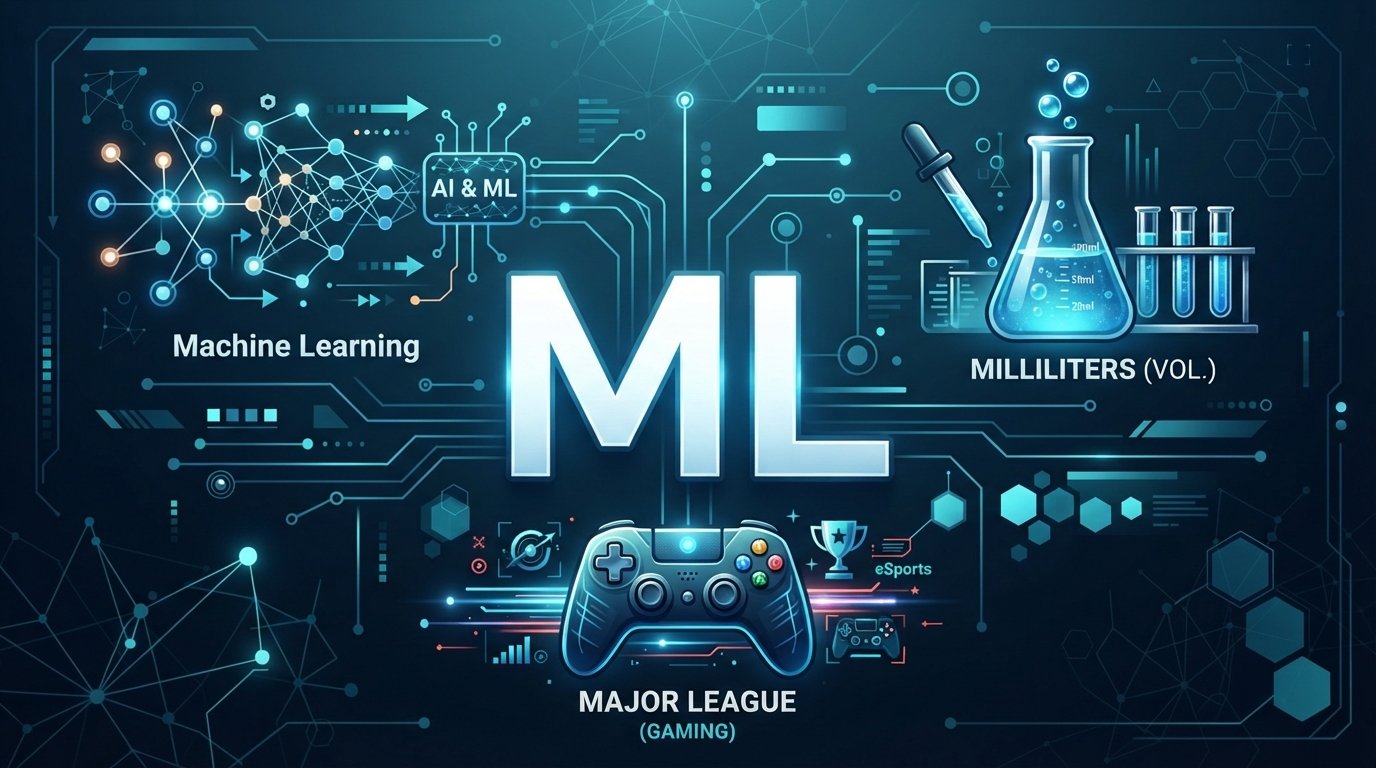
Beyond the four major interpretations above, ML pops up in a handful of other contexts worth knowing:
- Machine Learning: As covered above, a subset of artificial intelligence focused on building systems that learn patterns from data.
- Milliliter: A standard metric unit of volume, commonly seen in recipes, medical dosages, and scientific measurements (“take 5 ml twice daily”).
- Mobile Legends: The mobile game and online gaming phenomenon, especially popular in the Philippines, Indonesia, and across Southeast Asia.
- Middle Linebacker: In American football contexts, ML occasionally refers to this defensive position, though this usage stays fairly niche outside sports discussions.
- My Life: Less common, but occasionally used in very casual or intimate texting between close friends or partners, similar in tone to “ML” as “Much Love.”
Most of these meanings won’t confuse you in context. Nobody’s going to think you’re talking about milliliters in the middle of a gaming chat about ranked matches.
Common Mix-Ups: How to Tell Which ML Someone Means
Here’s a practical decoding method for the moments when ML genuinely feels ambiguous:
- Check who’s texting you. A close friend signing off is almost certainly saying “Much Love.” A coworker in a project channel probably means Machine Learning.
- Look at the surrounding words. “Play ml” points to gaming. “Model needs retraining, ml is acting up” points to Machine Learning. “Take care, ml” points to Much Love.
- Consider the platform. Instagram captions lean toward affection. GitHub issues and Slack threads lean toward the tech meaning. Discord gaming servers lean toward Mobile Legends.
- Think about tone. Warm, casual, sign-off energy usually means “Much Love.” Neutral, technical, or instructional tone points elsewhere.
- When in doubt, ask. Nobody’s offended by “wait, do you mean much love or the game lol.” It happens more often than you’d think.
These contextual terms and clues do most of the work. You rarely need to guess blindly because conversations almost always leave breadcrumbs.
Slang Terms People Confuse With ML
A handful of other abbreviations live in the same neighborhood as ML, and people sometimes mix them up:
| Abbreviation | Meaning |
|---|---|
| ILY | I Love You |
| HBU | How About You |
| WYD | What You Doing |
| TY | Thank You |
| LMK | Let Me Know |
| NP | No Problem |
ML sits closest to ILY in emotional tone, but it’s noticeably less intense. Where ILY signals romantic or deep familial love, ML feels warmer than a plain “bye” but far more casual than “I love you.” It’s the texting equivalent of a friendly hug rather than a heartfelt declaration.
Real Chat Examples
Seeing ML in actual conversation examples helps cement how naturally it fits into normal texting rhythm. Here are a few realistic exchanges:
Example 1 — Friends texting:
Sam: can’t talk tonight, family dinner running late Jordan: no worries, have fun! ml Sam: ml, talk tomorrow 💛
Example 2 — Gaming group chat:
Alex: anyone free to squad up in ml later? Priya: yeah I’m down, gimme 20 mins Alex: bet, I’ll queue us up
Example 3 — Work Slack channel:
Dana: the ml model’s accuracy dropped after the last data pull Theo: did we check for data drift? Dana: checking now, will update the thread
These three texting examples show how identical letters carry three completely different meanings depending purely on setting and tone. That’s the core skill here: reading context instead of memorizing a single fixed definition.
How to Reply When Someone Sends You “ML”
If someone texts you “ml” as a sign-off, you’ve got plenty of natural ways to respond depending on your relationship with them.
Casual Replies
- “ml too!”
- “aww ml”
- “back at you, ml”
Funny or Witty Replies
- “ml but also please text me when you land lol”
- “ml, don’t disappear on me again for a month”
- “noted, filing this under ‘reasons you’re my favorite'”
Warm & Friendly Replies
- “sending you so much love right back 💛”
- “ml always, you know that”
- “means a lot, ml right back”
More Formal Replies (coworkers, acquaintances)
- “Thanks so much, take care!”
- “Appreciate that, talk soon.”
- “Likewise, have a great rest of your week.”
If it’s the gaming version, your reply looks completely different: “bet, I’ll hop on in 10” or “can’t tonight, maybe tomorrow.” And if someone’s asking about the tech meaning, you’d respond with something relevant to the actual machine learning discussion at hand.
Is ML Still Used in 2026?
Slang has a shelf life, and it’s fair to ask whether ML still holds up. The short answer: yes, though its popularity varies by platform and audience.
“Much Love” as a sign-off has stuck around because it fills a genuine gap. It’s warmer than “bye” but less intense than “love you,” which makes it useful across a wide range of relationships, from close friends to online communities where people want to express appreciation without sounding overly personal.
The Mobile Legends usage of ML shows no signs of slowing down either. The game maintains an enormous active player base, particularly across Southeast Asia, and abbreviations tied to popular games tend to stick around as long as the game itself stays relevant.
Meanwhile, ML as shorthand for Machine Learning has only grown stronger. As AI technology becomes more embedded in everyday products, conversations referencing data models and predictive algorithms happen constantly across tech teams, making this meaning arguably more common now than it was five years ago.
So rather than fading out, ML has actually branched into more contexts over time. New audiences keep adopting it for new reasons, which is part of why decoding it correctly matters more than ever.
FAQs
Does ML mean “much love” or “my love”?
ML almost always means “Much Love” in casual texting and social captions. “My Love” isn’t a standard expansion, though it could apply in a private, intimate exchange.
Is ML the same as ILY?
No. ILY (I Love You) signals deeper romantic or family affection, while ML feels lighter and friendlier, more like a warm goodbye than a declaration.
Is Mobile Legends still popular enough for “ML” to mean the game in 2026?
Yes. Mobile Legends: Bang Bang has crossed 1.5 billion lifetime installations across 139 countries as of January 2026, and it has over 110 million monthly active users according to Moonton’s official figures, so the gaming meaning is still very much alive in chats and Discord servers.
Is “ML” still relevant for machine learning in tech conversations?
Absolutely, and arguably more than ever. As AI-driven products keep expanding, teams reference ML constantly when discussing data models, predictive systems, and product features.
What does ML mean on Instagram, Snapchat, or TikTok specifically?
On all three platforms, ML almost always means “Much Love,” typically used in captions or comments to express warmth or gratitude toward followers or a specific person.
conclusion
ML meaning in text really comes down to context. It can mean “Much Love” in a warm text, “Mobile Legends” in a gaming chat, or “machine learning” in a tech talk. The letters stay the same. The meaning shifts around them. Once you know the clues to look for, you’ll never feel confused again.
That’s the real value of understanding ML meaning in text. You read the room, not just the letters. Next time “ml” pops up in your messages, you’ll know exactly what it means and exactly how to reply.








1 thought on “ML Meaning in Text: What It Really Means in Chat, Social Media & Slang 💬”